
R. Hurtado-Gutiérrez, C. Pérez-Espigares, P.I. Hurtado

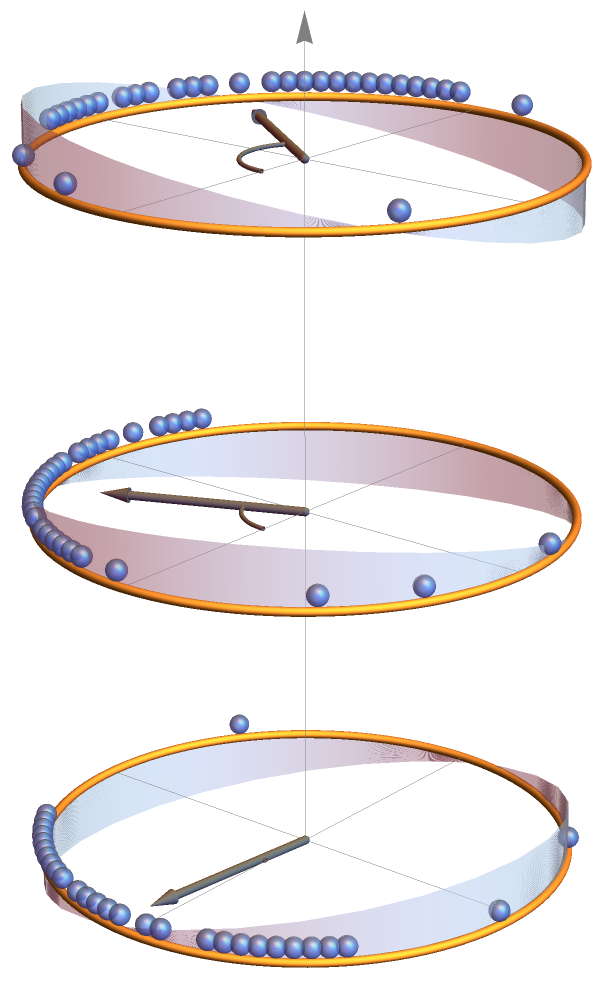
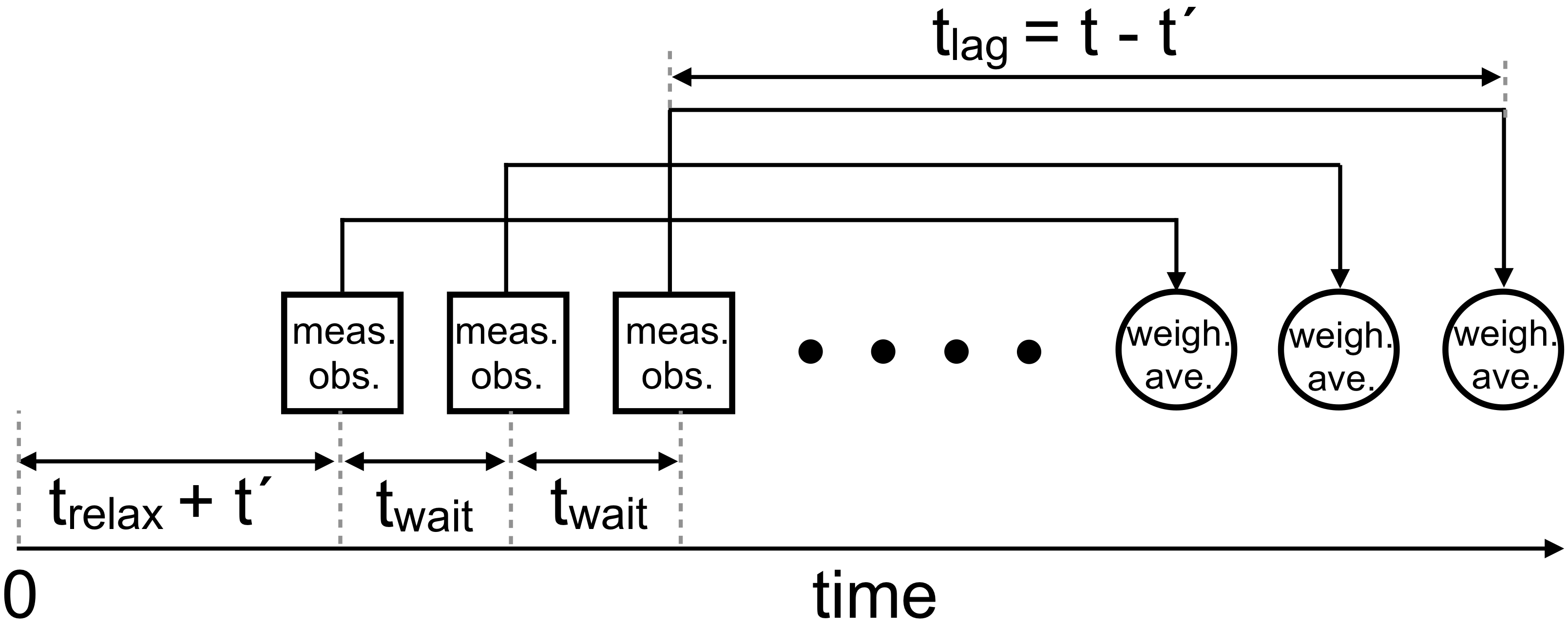
Time crystals are many-body systems whose ground state spontaneously breaks time-translation symmetry and thus exhibits long-range spatiotemporal order and robust periodic motion. Using hydrodynamics, we have recently shown how an mth-order external packing field coupled to density fluctuations in driven diffusive fluids can induce the spontaneous emergence of time-crystalline order in the form of m rotating condensates, which can be further controlled and modulated. Here we analyze this phenomenon at the microscopic level in a paradigmatic model of particle diffusion under exclusion interactions, a generalization of the weakly asymmetric simple exclusion process with a configuration-dependent field called the time-crystal lattice gas. Using extensive Monte Carlo simulations, we characterize the nonequilibrium phase transition to these complex time-crystal phases for different values of m, including the order parameter, the susceptibility and the Binder cumulant, from which we measure the critical exponents, which turn out to be within the Kuramoto universality class for oscillator synchronization. We also elucidate the condensates density profiles and velocities, confirming along the way a scaling property predicted for the higher-order condensate shapes in terms of first-order ones, discussing also novel possibilities for this promising route to time crystals.



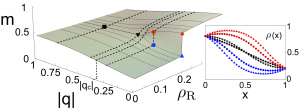 Driven diffusive systems may undergo phase transitions to sustain atypical values of the current. This leads in some cases to symmetry-broken space-time trajectories which enhance the probability of such fluctuations. Here we shed light on both the macroscopic large deviation properties and the microscopic origin of such spontaneous symmetry breaking in the weakly asymmetric exclusion process. By studying the joint fluctuations of the current and a collective order parameter, we uncover the full dynamical phase diagram for arbitrary boundary driving, which is reminiscent of a ℤ2 symmetry-breaking transition. The associated joint large deviation function becomes non-convex below the critical point, where a Maxwell-like violation of the additivity principle is observed. At the microscopic level, the dynamical phase transition is linked to an emerging degeneracy of the ground state of the microscopic generator, from which the optimal trajectories in the symmetry-broken phase follow. In addition, we observe this new symmetry-breaking phenomenon in extensive rare-event simulations of the microscopic dynamics.